
Flights
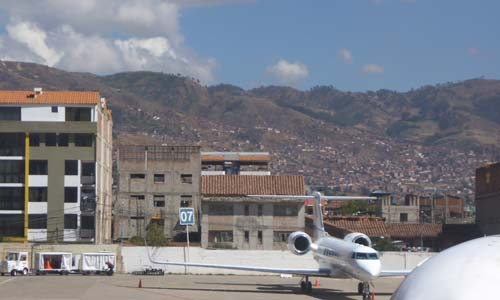
Flying is the best way to travel between the major cities of Peru. Alternately, your guide may suggest a tour bus to travel between cities. This is a viable option, if you want to save money and don't mind the extra time.
You can book your own flights, or have a guide book them for you. Booking a multi-city flight may be less pricey than booking flights separately.
International Flights to Peru
Most major carriers fly into Lima, Peru. They usually arrive in the middle of the night, around 1 a.m. If you are flying on to another city, you will likely change planes and fly a South American carrier for your connecting flight. You will go through customs and immigration in Lima.
If Lima is your first stop, you can exchange money from Dollars to Soles after customs, but before you exit security. That way you will have money to pay the taxi. Since your flight will arrive in the middle of the night, book a hotel for the day before you will arrive. For example, if you arrive May 1 at 1:30 am, and have a hotel booked for May 1, you won’t be able to check in until 12 hours later, around 2 p.m. If you book April 30, your hotel will be waiting for you when you arrive.
Domestic Flights in Peru
Lan and Avianca are the two main carriers that fly within Peru. During our missionary tour, we flew Avianca for our international flights and LAN for our domestic flights. Both LAN and Avianca were on time, professional, and good airlines. They gave instructions both in English and Spanish.
We purchased our Avianca flights with Frequent Flyer Miles through United Airlines, and we booked our LAN flights directly through the LAN website. We had to call our credit card to get them to approve the charge to LAN. Our bank thought it might be fraudulent because it was originating in a South American country. You could also buy your tickets from a 3rd party site like Kayak or Expedia.
Airport Rules
In Peru, you are supposed to arrive 3 hours early for international flights, 2 hours early for domestic. The ticket counter opens 2 hours early. You will need to show your passport and immigration paper that you received when entering Peru. They will check the weight of all your bags, including your carry-ons. To leave the country, you must have your immigration paperwork. Keep it safe. Your missionary will have to show paperwork declaring that they no longer wish to be a resident of Peru. The mission office will prepare that paperwork for you.
Luggage Allowances in Peru
For flights within Peru, each person is allowed to check 2 pieces of luggage that have a combined weight of 50 lbs. plus a carry on that weighs 17 lbs. and a backpack or purse that isn’t weighed. If you fly business class, your checked luggage weight doubles. We brought an empty duffel bag in our luggage to fill with our souvenirs. We filled that, and had to also purchase another piece of luggage to fit all of our purchases. Check with your airline for up to date luggage information.
LAN Airlines Avianca Airlines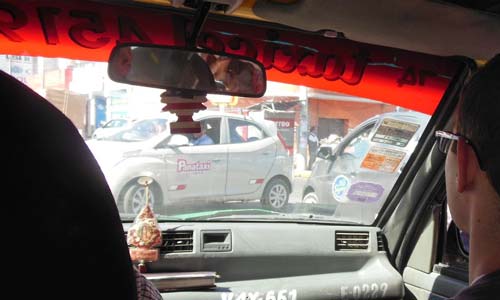
Car Rental
I would not recommend renting a car. The driving in Peru is not what you're use to. Stop lights, stop signs, and traffic lanes are only suggestions, and are usually not followed. We had taxi drivers drive right past stop signs without even slowing, even when cars were coming the other way.
At stop lights, two lane roads usually had 4-5 cars side by side. Often before the light would turn green, the cars would ease out into the traffic going the other way, and slowly thread their way through the intersection. If the driver wanted to merge into traffic, he just stuck the corner of his car in between two cars where there wasn’t room, and forced his way in.
The most nerve wracking experience was taking a mini bus in Arequipa out into the surrounding rural area. If a car was going too slow, the driver would swing into oncoming traffic, race ahead, and cut off the person he was passing in order to avoid being hit by cars coming the other way. If there was a long line of cars he was trying to pass, he might spend up to 5 minutes on the wrong side of the road, only swinging back in the nick of time to avoid a collision. He would pull into oncoming traffic on blind corners, before tunnels, and whenever he felt like it with no regard to the striping on the road.
Taxis
Prebooking your Taxi
If it makes you feel safer, you can prebook your taxis over the Internet. If you don’t speak Spanish, I would recommend prebooking any taxis you will need before you connect with your missionary. Most taxi drivers don't speak English, so it is a good idea to have all of your destinations, with addresses, printed out ahead of time.
I used Taxidatum to prebook my taxis in Lima. Leonardo emailed back and forth with me as the dates and times of my flights changed, and he was very helpful. He spoke great English, and it was very nice to know that someone would be waiting for me when we arrived.
We probably paid more than we would have if our son had just hailed a cab. We paid $20 from the airport to the hotel, $15 per hour to take us around to different museums. If I were to do it again, I'd probably prebook the airport taxi, but have my son hail taxis the rest of the time rather than pay for a taxi tour.
TaxidatumHailing Taxis on the street
Your missionary should be able to hail taxis easily. Check with your missionary. If they are comfortable with it, just plan to grab taxis on the street. They are everywhere.
Guidelines to safely use taxis in Peru
- Make sure you agree on a price before you get into the taxi. We paid S/.25 (Soles) from the airport to the hotel, and between S/.6 - 15 for shorter taxi rides around town.
- Don’t be afraid to say no and find another taxi if you don’t like the price.
- Pick taxis that are from big companies like Megatur, Taximundo, and Taxitel.
- Pick taxis that looked nice, not run down.
- Have your hotel call you a taxi for you. It may cost a little more, but you can trust it is from a reputable company.
- If you find a taxi driver that you like, talk to them and see if they will drive you on all your excursions in the city.
Trains, Busses, and Combis
Trains
The train is the only way to get to Aguas Calientes, the town at the base of Machu Picchu, unless you want to hike. You can buy train tickets online, or you can get it as part of a Machu Picchu tour package purchased through a guide.
The train takes about 45 minutes from Ollantaytambo and expensive--$115 round trip per person. There are two train companies, Peru Rail and Inca Rail. If you purchase train tickets online, you have to validate them at a Peru Rail or Inca Rail location once you arrive in Cusco. You can do this at the airport.
Note, the train does not take you all the way from Cusco to Aguas Callientes. If you don’t book a Machu Picchu tour, you will need to arrange travel by taxi from Cusco to Ollantaytambo.
Busses
Busses are an alternative to flights between major cities. They can also be used to get to outer areas of a mission to visit church members. We took a bus from Arequipa to an outlying area of Pedregal, where we went to church. It was a 2 hour ride. The minibus was basically a 15 passenger van. The ride was S/.8 per person, and it was quite an adventure, because the driver drove on the wrong side of the street almost as much as he drove on the right side of the street. Busses can be booked by a tour guide or online. Bus trips, especially to outlying areas really don't need to be scheduled ahead of time. You may want to wait until you are with your missionary so they can help you book it, or you can check the schedule and just show up at the terminal before the bus is scheduled to leave.
Terminal Terrestre Bus WebsiteCombis
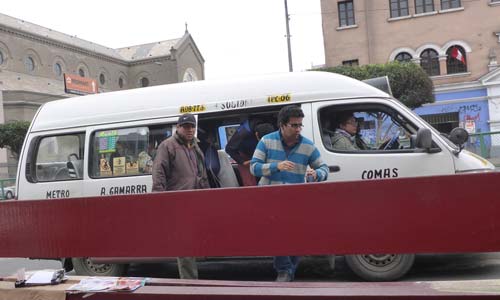
Combis are mini-busses that travel the same route over and over in a city. Often these combis are large vans with the seats removed, and replaced with benches around the perimeter. Combis are very cheap, but also somewhat dangerous. They race through the streets. They have people that stand on corners throughout the city, timing how fast they are making their circuit. If they fall behind while stopping to pick up passengers, they have to speed up to make up lost time. They only stop for a few seconds to pick up or drop off passengers, so you have to be quick.
Combis are often involved in accidents, and they cram many more people into them than is safe. Combis are also a favorite spot for pick-pockets, so use them with caution. If your missionary is familiar with riding Combis, they may want to take you on a ride just for the experience. The one we rode on was very similar to a regular city bus in the US, but smaller. My son said we were on one of the nicest ones. We stood in the aisle, and held onto a bar that ran above our heads.
Walking
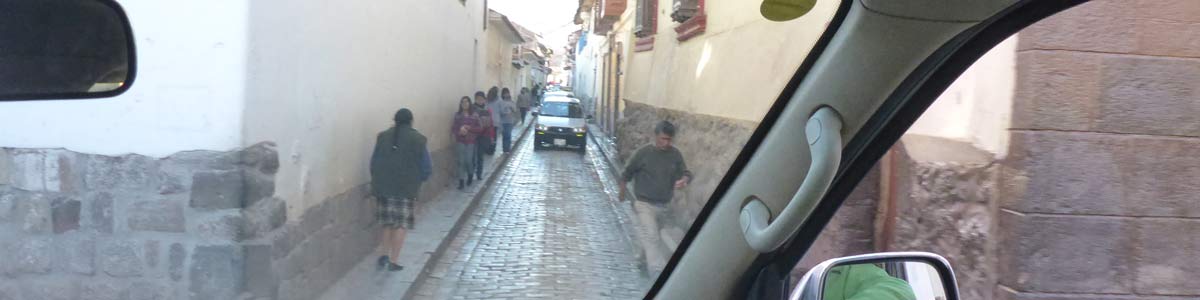
There are areas that are safe to walk, and others that are not. The Miraflores district in Lima is a fun place to walk. There are many shops and restaurants, as well as a large ruin right in town. There are some great places to walk around in Arequipa and Cusco as well.
You will likely walk as you visit outlying areas to see members that your missionary has worked with. Just try to stay in well lit, tourist areas, or places that your missionary is familiar with.